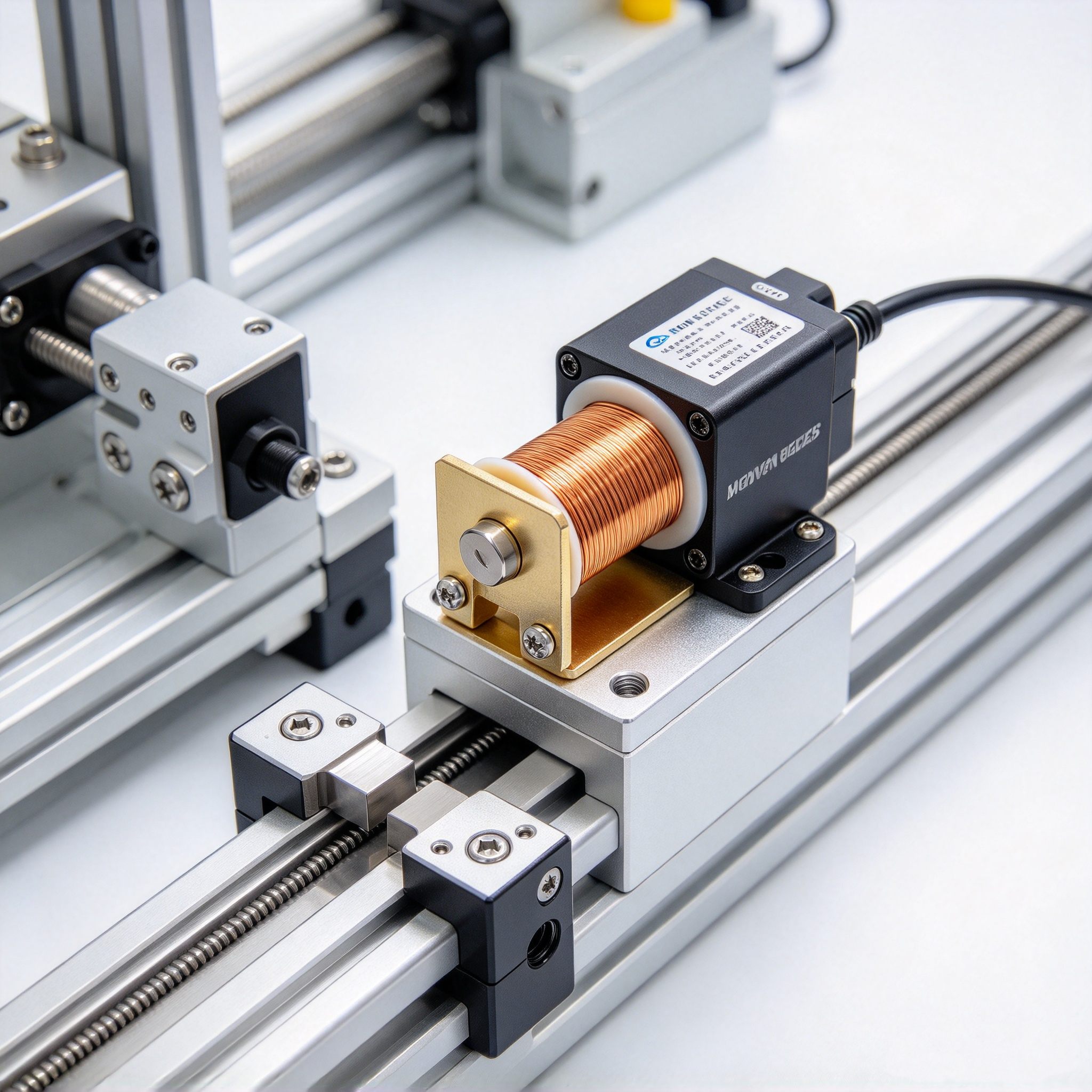
Coil-type Electromagnet 1. Product Introduction 1. Basic Definition A coil-type electromagnet is an electromagnetic drive device centered around an electromagnetic coil. It relies on the magnetic field generated by an electrified coil, paired with an iron core to achieve magnetic force output. It is the basic type of various electromagnets. In a broad sense, it includes both hollow coil and iron-cored structures. Many push-pull and suction cup electromagnets essentially contain coil components; in the industry, the term coil-type electromagnet is often used to refer specifically to hollow coils or independent coil electromagnetic components with a movable iron core.
Core principle: When current is passed through a coil, a magnetic field is formed inside and around the coil based on the principle of electromagnetic induction. Inserting a magnetic conductive core into the coil can significantly enhance the magnetic field strength, and the magnetic field is utilized to achieve actions such as attraction and driving. When the power supply is cut off, the magnetic field rapidly weakens.
2. Main structure: enameled wire winding (coil body), insulating frame, iron core/moving armature, insulating protective layer, lead terminal; hollow type without iron core.
3. Product Features: Simple structure, with coil as the main body, compact size, flexible design; controllable magnetic field: generates magnetic field when energized, dissipates when de-energized, and the magnetic force can be adjusted through current; distinction between hollow/cored: hollow coil has weak magnetic field and light weight; magnetic force is significantly improved after adding a core; generates heat when energized, the greater the current, the more pronounced the heating, requiring control of energization duration and current; strong functional extensibility, can be combined with springs, armature, and housing to transform into push-pull or suction cup type electromagnets.
4. Key selection parameters: rated operating voltage (DC/AC), coil resistance, rated current, current-carrying duration rate ED%, coil inner diameter, outer diameter, height, maximum output magnetic force, lead wire method, insulation level, temperature resistance level. Note: Hollow coils have weaker magnetic force and are generally used for induction, magnetic field testing, and small drives; only core-equipped coil-type electromagnets are suitable for mechanical actuation.
II. Coil-type electromagnets are used as basic electromagnetic components in various industries, either standalone or integrated as core components within various devices:
Instruments and Meters: Sensors, electromagnetic testing devices, magnetic field generators; Small solenoid valves: electromagnetic drive coils for fluid valves, coil assemblies for air valves and water valves; Automation Equipment: small electromagnetic exciters, sorting mechanisms, electromagnetic oscillators; Consumer Electronics: small vibration components, electromagnetic switches, unlocking mechanisms; Teaching Experiments: electromagnetic experiment teaching aids for physics; Low-Voltage Electrical Apparatus: electromagnetic coil assemblies for relays and contactors.
III. Frequently Asked Questions (FAQ) Q1: What is the relationship between coil-type electromagnets and push-pull or suction cup-type electromagnets?
A: The coil is the core component of an electromagnet. Push-pull and suction cup electromagnets are both finished products, equipped with a housing, armature, and return spring; coil-type electromagnets mostly refer to coil assemblies (which can be hollow or equipped with a core), which can be used as semi-finished products and combined with other structures to create different types of electromagnets according to specific needs.
Q2: Does an air-core coil electromagnet have attraction force?
A: An air-core coil can generate a magnetic field, but its magnetic force is relatively weak, making it difficult to directly attract heavy objects. It is mostly used for magnetic field excitation and induction, and is not suitable for direct use as an attracting actuator. The magnetic force will be significantly enhanced after adding an iron core.
Q3: Can a coil-type electromagnet be energized for a long time?
A: It depends on the insulation level and the power-on duration. Prolonged continuous power-on will accumulate heat, and excessive temperature will damage the enameled wire insulation, causing the coil to short circuit and burn out.
Q4: How to adjust the magnetic force?
A: Under the premise of maintaining the structure unchanged, the input current can be adjusted; the coil turns, core material, and dimensions can also be altered to change the strength of the magnetic field.
Q5: Can we customize coil-type electromagnets?
A: Customization is supported, with adjustable skeleton size, wire diameter, number of turns, lead-out method, and insulation temperature resistance level.